Published: March 23, 2026
By: Stefan Gabriel, Head of Digital Solutions, OVD Kinegram AG
Identity verification technology and processes are experiencing ongoing transformation. As we move further into 2026, remote ID verification has changed from a “nice-to-have” to a core infrastructural requirement for many organizations and institutions, supporting onboarding, access to services, and regulated workflows.
At the same time, the threat landscape is shifting quickly: generative AI dramatically reduces the cost of creating convincing forgeries, and attackers focus on targeting the weakest link in remote verification pipelines. Typically, these are decisions which rely primarily on images.
Against this background, the present article focuses on a practical question many teams face:
In times of AI fraud and digitizaion, how do you choose identity verification technology that delivers high assurance remote ID verification?
Remote ID Verification Stacks, High Assurance and AI Fraud
When teams evaluate identity verification technology for remote ID verification, it is important to understand and establish the necessary functions, rather than individual products. High assurance remote identity verification is a set of functions that answer two questions:
- Is the identity evidence genuine and valid?
- Is the person presenting the evidence the real, live subject linked to that evidence?
A practical way to then choose identity verification technology is to ensure that solutions cover the following capability areas:
- Capture-channel integrity: Ensure the technology can secure the capture pipeline, i.e., preventing document and selfie/video inputs from being injected, replayed, or tampered with. Images must undoubtedly come from a real-time session, document data is best obtained from the NFC chip.
- Document capture and visual checks: Your stack should support validation that the supplied document is present, genuine, and not counterfeited. This core requirement is maintained by many governmental digital identity verification guidelines, for example those published by the NIST for the United States.
- Biometric liveness, presentation attack resilience: In remote ID verification, technology stacks must ensure the live presence of the document holder.
- High assurance document verification and holder binding: Especially for medium- and high-risk use cases, the identity verification technology should include chip-based document verification along. In addition, it must clearly establish the link between the validated document and the person presenting it.
- Evidence recording for auditability and defensibility: Selecting identity verification technology is also selecting what you can later prove about a decision. Tech stacks should ensure that decisions are both plausible as well as operationally defensible afterwards.
The key is not to pick “the best” component, but the most defensible combination of components for your use case, while making sure to secure your identity verification process flow against AI-enabled fraud.
How AI-driven fraud impacts the technology decision
In contrast to trained manual or robust machine-based verification of a physical identity document, the digital use of these credentials in remote ID verification situations is highly sensitive – and highly problematic when relying only on visual evidence. A growing share of identity fraud in remote scenarios is designed to defeat systems that trust pixels.
Artificial Intelligence, in particular generative AI, has been shown to make sophisticated fraud achievable by anyone with a computer or a smartphone. Threat reporting focusing on GenAI risks highlights increasing pressure from deepfakes and AI-driven attack vectors across the customer lifecycle, including remote onboarding.
At the same time, attackers are not only manipulating what the camera “sees”, but also increasingly targeting how the system receives the input:
- Presentation attacks: spoofing what is presented to the sensor/camera by showing something deceptive, for example a high-quality screen replay. The ISO/IEC 30107 family provides a framework for specifying and detecting fraud events of this type. Also, ENISA’s work on remote identity verification focuses on threats and controls in this domain.
- Injection attacks: manipulated media is fed into the pipeline, bypassing the sensor/camera. These attacks are increasingly discussed as a distinct and growing class of threats in remote ID verification. Threat intelligence reports highlight strong growth of injection- and emulation-based approaches.

Taken together, these AI-driven realities explain why chip verification plays a central role in high assurance remote ID verification: It provides a defensible, cryptographic validation step that remains robust and significantly raises assurance even as AI-generated forgeries continue to improve.
For a broader view of how AI fraud and other developments are reshaping the ecosystem, see our Trends in Identity Verification 2026 article.
What this means for remote ID verification
If you are choosing identity verification technology for remote ID verification in 2026, here are three practical implications.
- Image-only checks are severely limited. Even with strong visual analysis, remote ID verification flows that rely mainly on photos or video remain more exposed to spoofing and manipulation.
- Defend the capture pipeline and the detection model. Liveness checks help against presentation spoofing. Make sure your technology stack can also detect injection fraud. Treat capture-channel integrity as a first-class selection criterion.
- Use cryptographic validation for high assurance. Wherever documents support it, integrate NFC chip verification into your process flow. It validates the issuer-signed data using cryptographic mechanisms and offers high assurance verification.
Chip Verification as Principal Identity Verification Technology
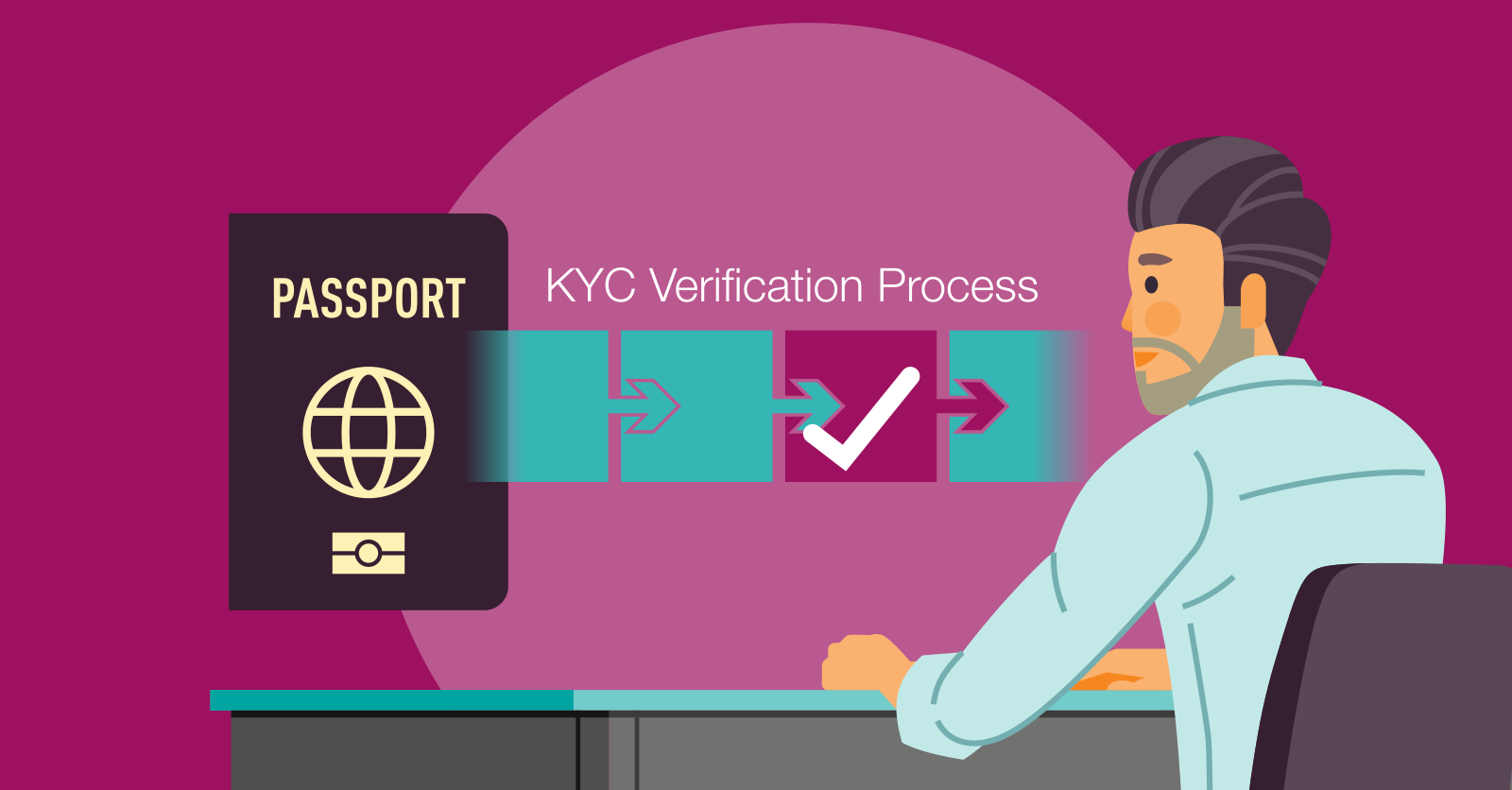
Chip verification, recommended by ICAO as well as governments to form an integral part of digital verification trust frameworks, effectively mitigates AI threats. Cryptographically verifying a person’s identity by using the electronic chip of a physical credential, such as a biometric passport or identity card, strengthens document authenticity verification and provides a reliable result.
Chip verification offers a different security paradigm than “Does it look real?”:
- Visual checks can be fooled by high-quality forgeries and synthetic images.
- Chip verification validates cryptographically protected data, which is substantially harder to counterfeit than visual appearance.
The security provided by electronic chips in documents is highly immune to fraud attempts. The data and personal information stored on the chip are strongly secured against cloning or tampering. Sophisticated verification solutions ensure to thoroughly check for cloning or other forgeries, providing the necessary reliability and assurance for digital identity verification.
In practice, chip verification can help eliminate false accepts from image-driven attacks and provide strong evidence for audits or dispute handling. For more information on the technicalities of chip verification, refer to our article on the verification process or ICAO’s Doc 9303.
Where chip verification is especially valuable
Chip verification is especially recommended for medium- or high-risk remote ID verification scenarios, where decisions must be defensible and fraud pressure is high, including
- Cases where assurance must be defensible, for example in highly-regulated customer onboarding for banks and financial institutions or in public-sector identity verification processes for accessing essential services.
- Defense against threat models that include AI-generated document imagery and other appearance-based deception.
- Situations requiring strong evidence for audits, disputes, or incident response.
- Workflows where reducing ambiguity matters – less false positives mean fewer costly escalations.
Expert opinion: Key takeaways on choosing identity verification technology
“In remote identity verification, the most expensive failures often appear at later stages – for example when an unauthorized passenger must be returned, a rented vehicle is stolen, or social benefits are fraudulently claimed. The root cause is usually an identity decision which was not established with strong evidence. Chip verification helps because it moves the check from “looks authentic” to “cryptographically verified”, ensuring data integrity, authenticity, and chip genuineness. This is increasingly important as AI improves image-based deception.”

Stefan Gabriel
Head of Digital Solutions
Kinegram Digital SolutionsChip Verification is Central to High Assurance Remote ID Verification
Remote ID verification is now mainstream, but AI-driven fraud makes the choice of identity verification technology more consequential than ever.
Identity verification technology stacks in 2026 must combine visual analysis with liveness checks, biometric verification, and high assurance document verification. For modern ePassports and eIDs, NFC chip verification is the gold standard. It validates issuer-signed data under ICAO’s eMRTD framework, offering extremely high assurance and trust.

FAQ – Identity Verification Technology
What is identity verification technology for remote ID verification?
Identity verification technology for remote ID verification is the combination of software and security controls used to verify a person’s identity remotely, without an in-person, on-the-spot check. It is not one tool, but a stack of capabilities that typically include secure capture, document validation, holder binding, biometrics and liveness, fraud detection and evidence logging.
Why is AI fraud a problem for remote ID verification?
Generative AI can produce convincing synthetic document imagery and deepfakes, which increases the risk for workflows that rely heavily on visual document checks. This is why high assurance identity verification technology adds stronger controls than image-only checks.
What is the difference between presentation attacks and injection attacks?
Presentation attacks try to fool the camera with a deceptive image. Injection attacks feed manipulated media into the verification pipeline, bypassing camera checks. Treating capture-channel integrity as a selection criterion helps to make identity verification technology stacks more robust and addresses both risks simultaneously.
How does NFC chip verification improve identity verification technology stacks?
Chip verification validates the integrity and authenticity of the chip data from an eMRTD such as a biometric passport, and ensures the genuineness of a chip through clone checks. It significantly strengthens the reliability of remote ID verification.
When should chip verification be included in remote ID verification processes?
Whenever assurance must be defensible, for example in regulated industries, remote onboarding, or government-offered public services for citizens; whenever AI-driven fraud is a risk; or when auditability and evidence retention are required.
Author
Stefan Gabriel
Head of Digital Solutions
Does your organization need fully reliable, defensible identity verification technology?
Discover our user-centric, privacy-first MOBILE CHIP SDK solution! It adds a robust layer of trust to your identity verification technology stack and offers a highly reliable and secure defense against multiple threats.
Are you looking for more information regarding ID verification for remote onboarding scenarios? Explore our solution for secure remote ID verification: Identity Document Verification for Onboarding.
Contact us for more information!

© OVD Kinegram AG
Imprint | Privacy Policy | Image credits
Privacy Notice | Terms and Conditions
LinkedIn Youtube