Kinegram Digital Solutions
  • Solutions
    • Rapid and Comprehensive All-In-One Scanning Solution
    • Identity Document Verification for Onboarding
    • Identity Establishment for Police Forces
  • Products
    • MOBILE SCAN SDK
      • MRZ Scanner Module
      • License Plate Scanner Module
      • 2D Barcode Scanner Module
      • VDS Scanner Module
    • MOBILE CHIP SDK
      • Supported Countries and Organizations
      • MOBILE CHIP SDK online
        • eMRTD Connector
        • DocVal Server
        • Demonstrator
        • Example Result
      • MOBILE CHIP SDK offline
    • KINEGRAM DIGITAL POLICING
      • MOBILE SCAN SDK
      • CHIP VERIFY
      • DOC LIBRARY
      • BANKNOTE SCANNER
    • VDS Bio
    • TRY IT YOURSELF
      • Demonstrators on Identity Verification
  • Use Cases
    • Banking
    • Airlines
    • Hotels
    • Car Rental
    • E-Government
  • About
    • Events
    • News and Press
    • OVD Kinegram
    • References
  • Resources
    • Demonstrators
    • Developer Hub
      • MOBILE SCAN SDK
      • MOBILE CHIP SDK online
      • MOBILE CHIP SDK offline
    • Evaluate our Software
    • Knowledge Base
      • Evaluate our Solution
      • Why Our Solution is Secure
    • Success Stories
      • Enhancing Identity Verification and Customer Onboarding
      • Fast, Reliable, and Universal Data Capture in the Field
      • Strengthening eKYC Excellence and Global Reach
    • White Paper
  • Contact
  • Click to open the search input field Click to open the search input field Search
  • Menu Menu

Identity Proofing: Definitions, Online Methods, How to Choose Solutions

Published: March 31, 2026

By: Stefan Gabriel, Head of Digital Solutions, OVD Kinegram AG

TL;DR

Identity proofing is the process of establishing that a person is who they claim to be by validating identity evidence and linking it to the live person. It is broader than identity verification (the actual validating evidence step) and different from identity authentication (checking later logins). In regulated environments, identity proofing is a building block for KYC verification. For identity proofing online, the most defensible way forward combines secure capture, evidence collection, evidence validation through a reliable document check, and holder binding. NFC chip verification can effectively strengthen document authenticity verification and provide highly reliable results.

Identity proofing has shifted from a niche onboarding step to a foundational element for digital services. Extensive options for remote customer onboarding, tighter compliance expectations, and AI-enabled fraud are raising the bar: many organizations now need identity proofing that is not only effective, but also defensible, meaning it can be explained, evidenced, and audited.

This reference guide gives a precise definition for identity proofing, clarifies how it differs from related terms, explains identity proofing online, and provides practical help for evaluating identity proofing solutions, especially for high assurance use cases.

Graphical Illustration of successful digital identity proofing - a woman shows a thumgs-up gesture next to a computer screen displaying a checklist with green check marks.

What is Identity Proofing?

Identity proofing is the end-to-end process of establishing that a person is who they claim to be, in order to grant them an account, an access, or a service, by collecting and validating identity evidence and linking that evidence to the live person. As the initial authentication step, identity proofing is central to digital identity services and commonly encompasses evidence presentation, validation, and verification at defined assurance levels.

Identity Proofing vs. Identity Verification vs. Identity Authentication

Identity proofing establishes trustworthy identity records for a person, for example in enrolment or onboarding. As an end-to-end process, it ensures that claimed identity attributes, such as a provided name, ID number and date of birth, are linked to the real-world person by verifying trusted evidence such as a government-issued identity document and/or biometrics.

Identity verification is a step within identity proofing processes, checking the authenticity and correctness of provided identity evidence. Identity verification makes sure that proofs are real and belong to the person presenting them.

Identity authentication happens after proofing. It is the process of confirming that a returning person is the same person whose identity was previously proofed. This can include the use of passwords, tokens, or biometric authentication.

A practical disambiguation of identity proofing vs. identity verification vs. identity authentication:


TermWhen it happensWhat it answersWhat it results in
Identity ProofingEnrolment, Onboarding“Who is this person?”Assurance decision, evidence record
Identity VerificationDuring identity proofing“Is the evidence real and linked to this live person?”Validated evidence, person-to-evidence link
Identity AuthenticationAfter identity proofing“Is this returning user the originally enrolled one?”Login / Access validation

Identity Proofing vs. KYC

Know-Your-Customer (KYC) is a broader compliance program that fulfils legal requirements for financial and other regulated entities to identify customers, assess risks, perform ongoing monitoring, and meet regulatory obligations. In many industries, KYC verification includes identity proofing as one of its key onboarding controls.

Identity proofing is an operational building block within KYC, especially in onboarding situations. It is also used outside of KYC, for example, to grant access to public services, for account recovery, or during workforce onboarding.

Identity Proofing in the Digital Identity Lifecycle

What can be called the digital identity lifecycle is essentially all the stages from creating a person’s digital identity or digital access, to managing it securely, to eventually deactivating it. Common frameworks include the following core phases:

  • Onboarding and identity proofing
  • Credentials issuance / Access granting
  • Ongoing use through authentication
  • Offboarding / Deactivation

Keeping lifecycle stages distinct helps choose the right solutions and controls at the right time. You will find more information on choosing sound identity proofing solutions further below.

Identity Proofing Online

Identity proofing online usually means some or all of the proofing steps happen remotely, via a digital channel. In practice, online identity proofing encompasses a stack of capabilities, not only a single feature, and each layer assumes the prior one is trustworthy:

  • Secure capture and session integrity:
    Goal: ensure the proofing inputs such as videos, selfies or document images come from a real-time capture session and have not been injected, replayed, or manipulated.
  • Evidence collection and document presence:
    Goal: confirm the user has presented identity evidence (e.g., an ePassport or an eID), collect the user’s personal data to save the need for manual entry (e.g., through MRZ extraction), and collect live images, including ensuring their usability (e.g., not blurred).
  • Evidence validation through identity verification:
    Goal: determine the authenticity and integrity of the evidence supporting the identity claim. Typical verification methods include document checks, for example through NFC chip verification for higher assurance and face matching.
  • Holder binding:
    Goal: confirm the live person is the rightful holder of the presented and validated evidence. This is usually done through liveness controls and biometrics.
  • Evidence recording:
    Goal: retain sufficient evidence and logs to support future audits as well as potential disputes or incident responses, while applying privacy-by-design and data minimization. A strong identity proofing process records what was checked, how, and what it means.

To read more about identity verification technology, refer to this article: Identity Verification Technology for Secure Remote ID Verification.

Threat Model: Why Identity Proofing is Changing

AI-enabled forgery is making online identity proofing more complex and challenging. Generative AI has significantly reduced the cost of producing convincing document fakes and deepfakes. This puts pressure on identity proofing processes, especially technology stacks relying heavily on image-centric decisions.

Two attack classes are especially relevant:

  • Presentation attacks spoof what the sensor or camera “sees” by presenting something deceptive, for example a high-quality screen replay.
  • Injection attacks feed manipulated media into the pipeline, bypassing the sensor/camera.

What do sound identity proofing outcomes and technology look like?

Sound identity proofing processes should build defensible assurance by combining layers, especially when AI-driven threats are in scope.

Evidence quality, assurance, and defensibility

Good identity proofing processes should produce a decision you can defend later. In practice, that means looking for:

  • Clear assurance target: the required assurance level is explicit and tied to the use case and threat model (including AI fraud)
  • Layered controls: capture-channel integrity + evidence validation + holder binding, with a defined step-up path for higher-risk cases
  • High assurance anchor: if available and suitable, a cryptographic method such as NFC chip verification for robust evidence validation
  • Evidence record: the system retains a minimal, privacy-aware audit trail of what was checked, how it was checked, and what the outcome means.

Chip verification as key component for higher assurance identity proofing

Where documents support it, NFC chip verification adds a cryptographic layer to identity proofing processes. It validates that issuer-signed chip data is authentic and untampered with, using cryptographic mechanisms, and reducing reliance on visual or image-based checks.

Chip-based methods can also strengthen anti-cloning assurance, which is especially relevant for high-stakes identity proofing. Chip verification is recommended by ICAO and several governments as an integral part of online identity proofing processes that require high trust levels. It can effectively strengthen document authenticity verification and provide highly reliable results.

8 Steps to Choosing Identity Proofing Solutions

Good identity proofing solutions are not defined by one feature, but by the overall stack matching threat models, assurance obligations, and operational constraints.

A short checklist to help examine existing or develop new identity proofing processes could contain the following guiding questions:

  1. Assurance target: What assurance level do you need to defend – internally, to auditors, to regulators?
  2. Use-case fit: Is this for KYC verification, access to services, workforce onboarding, or account recovery? What is the cost of a false accept?
  3. Evidence support: Which evidence types, such as ePassports or eIDs, and which geographies must be covered?
  4. Threat exposure: Are presentation or injection attacks in scope? Is the integrity of the capture channel ensured?
  5. High assurance path: Do you have or need cryptographic validation such as online and offline NFC chip verification?
  6. Holder binding quality: How do you combine liveness and biometric checks without over-collecting sensitive data?
  7. Auditability: What evidence is retained to defend decisions later, and how do you minimize data?
  8. UX and inclusion: Can users in remote locations or with accessibility constraints complete your identity proofing process successfully?

Key Takeaways

Identity proofing is the end-to-end process of establishing that a real person is who they claim to be, at a defined assurance level, before granting access or issuing a credential. It is related to, but distinct from, identity verification, a step within proofing, and identity authentication, the ongoing access controls after proofing. In regulated environments, identity proofing is a critical building block within KYC verification, while remaining relevant well beyond.

The conditions under which identity proofing processes must function are changing: remote channels are the new norm, regulatory expectations emphasize defensibility, and AI-enabled fraud raises the threat level. That is why effective identity proofing online is a technology stack encompassing secure capture and robust evidence validation, holder binding and auditable evidence records.

The practical implication: organizations should select identity proofing solutions based on assurance requirements and threat models, not on isolated features. Cryptographic NFC chip verification can provide a high assurance anchor within proofing processes and significantly strengthen document authenticity checks.

Kinegram Digital Solutions

FAQ – Identity Proofing

What is the meaning of identity proofing?

Identity proofing is the end-to-end process of establishing that a real person is who they claim to be, by validating evidence and linking this evidence to the live applicant at a defined assurance level.

What is the difference between identity proofing and identity verification?

Identity proofing is the overall process, for example conducted during remote customer enrolment. Identity verification is a step within the process. It confirms the validity and authenticity of presented evidence, and links the evidence to the live person presenting it.

What are the differences between identity proofing and KYC?

Know-Your-Customer (KYC) is a compliance program that fulfils legal requirements to identify customers, for example in financial institutions. Identity proofing is an operational component within KYC, especially in onboarding situations.

What is identity proofing online?

Identity proofing online means that parts or all of the proofing process are performed via digital channels, often remotely. It typically combines capture-channel integrity controls, identity verification steps such as evidence validation and holder binding, and an auditable evidence record.

What are the methods of identity proofing?

Common methods or steps within identity proofing processes include the verification of identity documents, including visual checks, reading and extracting data from machine readable zones, or online and offline NFC chip verification; as well as biometric checks, liveness checks, and sometimes database or authoritative source checks.

Why does NFC chip verification matter for identity proofing?

Where supported by documents, such as electronic passports or ID cards, online or offline chip verification enables the robust cryptographic validation of issuer-signed chip data. This strengthens identity verification checks significantly and makes them superior to image-only controls.

Kinegram Digital Solutions
Author

Author

Stefan Gabriel

Head of Digital Solutions

Kinegram Digital Solutions

Learn more about defensible identity proofing, remote onboarding, and KYC verification!

Explore our chip verification solutions that support high assurance identity proofing online: MOBILE CHIP SDK reads and verifies chip data of ID documents

Contact us for more information!

    First Name

    Last Name

    Company

    Position

    E-Mail *

    Phone

    Message *

    *

    I agree that my data from the contact form will be collected to answer my request and for marketing and sales purposes. You can find more information in our privacy policy.

    Related Reading on Identity Proofing

    Illustration of Identity Proofing showing a face overlaid with a network of data points

    Identity Proofing

    24. March 2026

    March 31, 2026

    Learn about identity proofing and how to distinguish identity verification and authentication. Explore online identity proofing, AI fraud risks, and how high assurance technology such as NFC chip verification helps achieve defensible identity proofing results.
    Read more
    Mastering KYC verification with Kinegram Digital Solutions

    Essential Strategies for Effective Identity Proofing and Client Onboarding

    22. October 2024

    January 29, 2025

    This article outlines essential strategies for mastering KYC verification and client onboarding processes, emphasizing the importance of security, automation, and regulatory compliance.
    Read more
    Mastering KYC verification with Kinegram Digital Solutions

    Future Trends in KYC and Identity Proofing

    22. October 2024

    January 22, 2025

    In this article, you will learn more about the future trends shaping KYC and identity proofing, driven by technological advancements, and evolving regulatory requirements.
    Read more
    Mastering KYC verification with Kinegram Digital Solutions

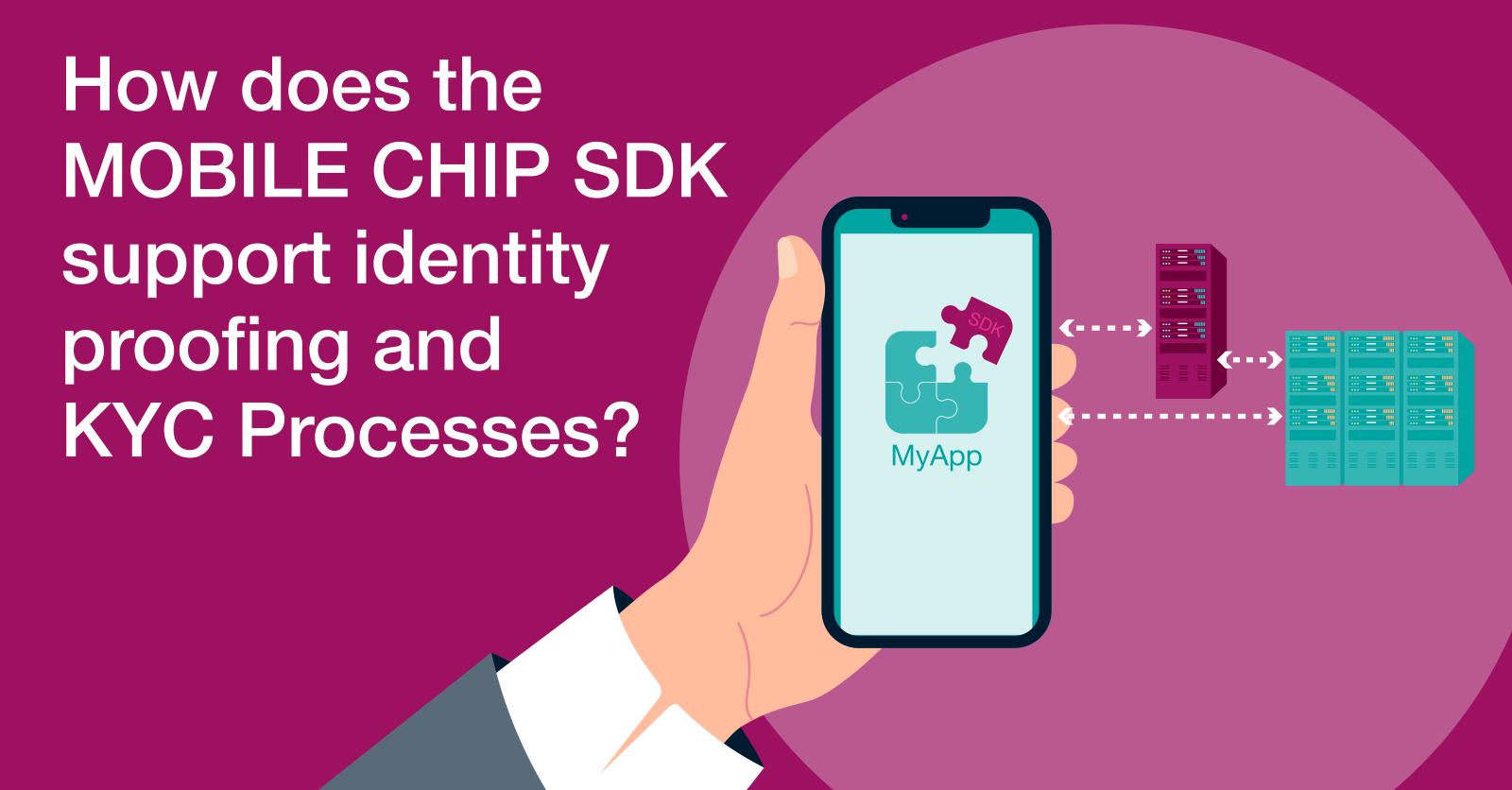
    How does the MOBILE CHIP SDK support identity proofing and KYC Processes?

    22. October 2024

    January 15, 2025

    This article explains how the MOBILE CHIP SDK supports identity proofing and KYC processes by offering real-time, secure verification of electronic identity documents via NFC technology.
    Read more
    Mastering KYC verification with Kinegram Digital Solutions

    Best Practices for Effective Identity Proofing

    22. October 2024

    December 18, 2024

    This article discusses best practices for effective identity proofing, focusing on ensuring data accuracy, implementing secure verification processes, and adopting self-service KYC solutions.
    Read more
    Mastering KYC verification with Kinegram Digital Solutions

    Identity Proofing Techniques

    21. October 2024

    December 4, 2024

    This article explores the evolution of identity proofing techniques, highlighting the shift from traditional in-person verification methods to modern digital solutions.
    Read more

    Contact

    White Paper

    Download White Paper "The Importance of Passports for Secure Identity Establishment" Download Whitepaper Whitepaper The Importance of Passports for Secure Identity Establishment

    Success Story

    Download Success Story "Enhancing Identity Verification and Customer Onboarding" Success Story Enhancing Identity Verification and Customer Onboarding

    RSS Knowledge Base

    • Identity Proofing
      March 31, 2026 Learn about identity proofing and how to distinguish identity verification and authentication. Explore online identity proofing, AI fraud risks, and how high assurance technology such as NFC chip verification helps achieve defensible identity proofing results.
    • Choosing Identity Verification Technology
      March 23, 2026 Identity verification technology and processes are experiencing ongoing transformation. As we move further into 2026, remote ID verification has become a core reqirement for many organizations and institutions. At the same time, the threat landscape is shifting quickly. In this article, learn how to choose identity verification technology that delivers high assurance […]
    • Chip Authentication for Mobile Identity Document Verification
      March 11, 2026 Chip authentication of electronic MRTDs is a high assurance solution for digital identity verification. Chip verification enables reliable and compliant ID checks, for example in remote customer onboarding scenarios. Our MOBILE CHIP SDK is a leading solution for trustworthy remote identity verification.
    • Trusted Devices vs. Untrusted Devices
      February 25, 2026 In this article you will learn what makes a device "trusted" or "untrusted" for identity verification, why the distinction matters for security and privacy, which scenarios require offline processing, and how to choose between MOBILE CHIP SDK online and MOBILE CHIP SDK offline based on your operational needs.
    • Trends in Identity Verification 2026
      February 4, 2026 The identity verification ecosystem continues to experience significant transformation. As we move into 2026, authorities, organizations and individuals are facing a complex environment that is strongly shaped by ongoing digitization and convenience, accompanied by more sophisticated fraud and higher assurance demands.

    Solutions

    • Overview

    About

    • OVD Kinegram
    • References

    Products

    • Overview
    • MOBILE SCAN SDK
    • MOBILE CHIP SDK
    • KINEGRAM DIGITAL POLICING
    • Demonstrators

    Use Cases

    • Banking
    • Airlines
    • Hotels
    • Car Rental
    • E-Government
    Kinegram Digital Solutions

    © OVD Kinegram AG

    Imprint | Privacy Policy | Image credits
    Privacy Notice | Terms and Conditions

    LinkedIn Youtube
    Link to: Choosing Identity Verification Technology Link to: Choosing Identity Verification Technology Choosing Identity Verification TechnologyCustomer Onboarding: Optical vs. Chip Identity Document Verification
    Scroll to top Scroll to top Scroll to top