Public Procurement for Identity Verification
How IDV Providers can Strengthen Their eID Tender Proposals

Lucia Meusburger
Marketing kinegram.digital
Marketing kinegram.digital
Published: August 10, 2026
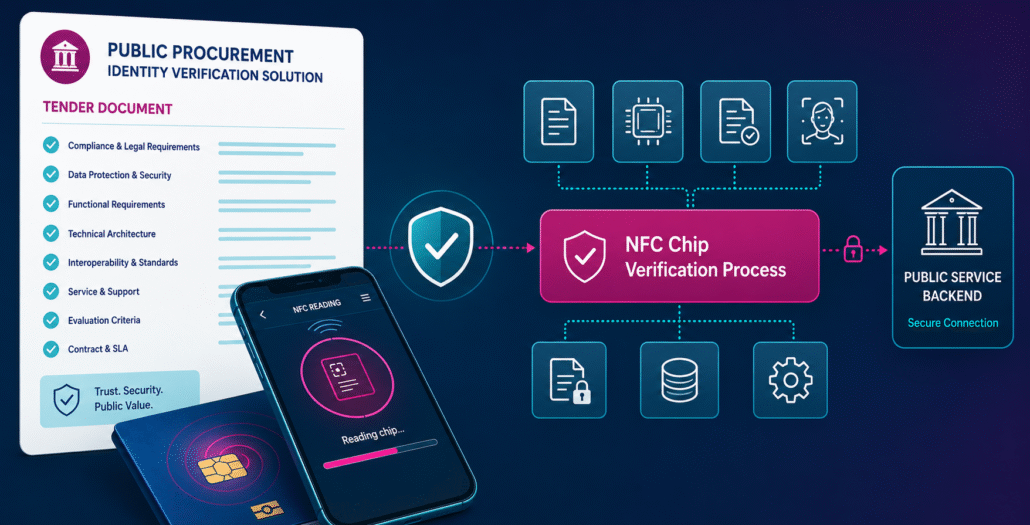
Government-developed digital identity programs are continuously expanding, requiring reliable identity verification (IDV) components. IDV providers, system integrators, and tender participants need to provide a credible trust layer for verifying government-issued identity documents in high-assurance digital environments. kinegram.digital’s MOBILE CHIP SDK provides secure, standards-based, trustworthy NFC-based chip verification for ICAO compliant biometric passports, ID cards, and other eMRTDs. MOBILE SCAN SDK can complement this by supporting the preceding MRZ capture step. Together, these solutions help tender participants add a specialist document capture and chip verification layer to broader IDV, eID, or e-government identity verification architectures.
Public-sector digital identity programs are moving from policy to implementation. Across Europe and beyond, governments are developing eID systems, digital identity wallets, and trusted e-government platforms and online public services. These require secure, reliable, and integration-ready identity verification components.
In public procurement for identity verification, IDV providers, system integrators, and tender participants need to show not only that their eID or public-sector identity verification proposal has a working user journey, but also, that it includes a credible trust layer for verifying government-issued identity documents in high-assurance digital environments.
Learn below how kinegram.digital’s MOBILE CHIP SDK enables highly trustworthy NFC-based chip verification for supported biometric passports, ID cards, and other eMRTDs, and how MOBILE SCAN SDK can complement this by supporting the preceding MRZ capture step. Explore how kinegram.digital supports IDV providers and system integrators as a specialist public-procurement partner, with chip verification expertise, identity document know-how, tender-phase support, and experience in demanding government and public-sector identity environments.
For a more technical view of how NFC chip verification supports public-service identity workflows, see our Use Case on NFC chip verification for e-government identity verification.
Talk to us about your tender or procurement requirements and how we can support you!
Digital identity is increasingly becoming operational public infrastructure. Governments are not only defining frameworks for electronic identity solutions; they are procuring, integrating, and operating the technical components needed to support secure digital services.
The EU Digital Identity Wallet is one example of this shift. Under the European Digital Identity Framework, EU Member States are expected to offer at least one version of the EU Digital Identity Wallets to citizens, residents, and businesses by the end of 2026, in line with the Regulation and Implementing Regulations.
Switzerland’s state eID and trust infrastructure is another example. The Swiss federal eID program describes the eID as a state-issued digital identity for use by citizens, public authorities, and businesses, with the state operating the necessary trust infrastructure for electronic credentials.
Spain’s MiDNI also shows how national digital identity initiatives are moving into practical use. For in-person transactions, the official MiDNI portal presents the DNI on a mobile device as playing the same role in the digital world as the physical DNI in the physical world.
For identity verification (IDV) providers and system integrators, this direction matters. As digital identity programs move from regulation to implementation, public procurement increasingly focuses on technical evidence: security, standards alignment, integration readiness, operational reliability, and the ability to support high-assurance identity verification in real-world public-sector workflows.
This is where specialist components become strategically important. A tender response may include the full IDV platform, user journey, orchestration layer, biometric checks, backend integrations, and operational services. But it also needs the right trust components inside that architecture, including reliable document capture and secure NFC chip verification for supported electronic identity documents.
Public-sector identity verification tenders are rarely simple technology purchases. They often involve long-term infrastructure decisions, multiple stakeholders, strict documentation requirements, and detailed evaluation criteria.
For IDV providers and system integrators, the challenge is not only to show that an identity verification solution works. They need to show that their proposed workflow is suitable for sensitive public-sector use cases.
A strong public-sector IDV proposal may need to address questions such as:
This is consistent with the broader procurement landscape for digital identity systems. The World Bank’s ID4D procurement guidance states that procurement of ID system components should be based on key design decisions, a needs assessment, the overall architecture of the ID system, and sufficiently detailed business and technical requirements.
For tender participants, this means a proposal is evaluated not only on the visible user journey. It is also evaluated on the quality of the underlying technical layers that establish trust.
Many IDV solutions include document image capture, OCR, MRZ reading, face matching, liveness detection, risk scoring, and case management. These capabilities are important parts of a complete identity verification workflow.
For public-sector eID, e-government and high-assurance identity verification tenders, however, tender participants may also need to demonstrate how the solution verifies the authenticity and integrity of data from supported electronic identity documents.
NFC chip verification is able to provide this specialist trust layer.
Electronic machine-readable travel documents, or eMRTDs, contain a contactless chip that stores identity data according to internationally defined specifications. ICAO Doc 9303 covers machine-readable travel documents, including the logical data structure for data stored on the chip, security mechanisms for eMRTDs, and public key infrastructure.
In practice, this means chip verification can help a public-sector IDV architecture move beyond visual inspection or OCR-based data capture alone. Instead of relying only on what is visible on the document surface, the solution can verify data from the document chip and check whether the data is authentic and unchanged, depending on the supported document and implemented security mechanisms.
For IDV providers, this is not a replacement for the broader platform. It is a trusted layer inside the platform.
For system integrators, it can reduce the need to build a sensitive chip verification component from scratch.
For tender participants, it can strengthen the technical credibility of a public-sector proposal by showing that the identity verification workflow includes a compliant and standards-based way to verify supported electronic identity documents.
MOBILE CHIP SDK is designed to provide the NFC chip verification layer inside broader IDV, eID, and e-government identity verification architectures.
For tender participants, the value is not only the SDK itself, but the ability to include a trusted, integration-ready chip verification component in a larger proposal.
As an NFC chip verification SDK, MOBILE CHIP SDK can support tender responses where the proposed solution needs to include:
For IDV providers, MOBILE CHIP SDK can act as a specialist verification component inside an existing identity platform. It can complement document capture, biometric matching, liveness detection, fraud signals, risk scoring, consent handling, manual review, and backend orchestration.
For system integrators, it can support a modular architecture. Rather than treating chip verification as an isolated technical feature, MOBILE CHIP SDK can be positioned as a dedicated trust layer within the complete public-sector IDV stack.
For public procurement, that distinction matters. Tender evaluators often need confidence that critical components are not improvised late in the project, but are technically mature, documented, and suitable for integration into demanding identity environments.
NFC chip verification is the main technical differentiator for high-assurance public-sector IDV proposals. This is where MOBILE CHIP SDK provides real added value.
However, chip verification does not usually stand alone in the user journey. Before a mobile device can access and verify the chip of a supported electronic identity document, the workflow often needs reliable MRZ reading to access the chip data.
This is where MOBILE SCAN SDK can complement MOBILE CHIP SDK.
MOBILE SCAN SDK supports the document capture layer of the identity verification flow. It can be used for mobile scanning of MRZ in identity documents, helping prepare the data needed for subsequent NFC chip access and verification. In addition, as a comprehensive scanning solution, MOBILE SCAN SDK can also capture data from a variety of other identifiers such as license plates, 2D barcodes, VDS or IDB.
Together, MOBILE SCAN SDK and MOBILE CHIP SDK can support a more complete document verification sequence:
For public procurement, this combination is useful because it shows that the proposal does not treat chip verification as an isolated step. It connects MRZ capture and chip verification into a practical mobile identity workflow.
This is especially relevant for IDV providers and system integrators that need to present a coherent architecture: from front-end document capture to secure chip verification and downstream integration.
Public-sector identity verification tenders require more than a technical component. They require an IDV tender partner that understands the environment in which that component will be evaluated, integrated, and operated.
kinegram.digital supports tender participants with a combination of digital identity expertise, identity document know-how, and public-sector procurement experience.
As the trusted layer for identities and identifiers, kinegram.digital is an eID tender partner and specialist public procurement partner for eID solutions that focuses on bringing trust into digital processes around identity documents, identity credentials, and reliable mobile verification. MOBILE CHIP SDK and MOBILE SCAN SDK are designed to support lean integration into broader IDV and public-sector identity verification workflows.
For more than 10 years, kinegram.digital has enabled chip-based verification of identity documents. As part of OVD Kinegram AG, kinegram.digital also builds on the group’s long-standing experience with governments and public authorities. OVD Kinegram AG has decades of procurement expertise and has worked with governments and public authorities around the world for more than 40 years. The company’s KINEGRAM technology is used to protect important identity documents in more than 120 countries.
This background matters in eID and public-sector IDV tenders because trusted digital identity verification depends on more than app integration. It is rooted in understanding identity documents, eMRTD standards, document security, trust chains, chip verification mechanisms, deployment models, and operational reliability.
“kinegram.digital can help IDV providers, system integrators, and procurement participants clarify NFC chip verification requirements, plan proof-of-concept activities, prepare technical documentation for tender responses, discuss suitable architecture for online, offline, on-premise, or controlled-environment deployment, and we can provide general identity document and eMRTD expertise. As a public procurement partner for eID solutions, we can especially be of service to organizations that already have a broader IDV platform or integration mandate, but need a specialist layer for secure document chip verification.”

When preparing an eID, digital identity, or public-sector identity verification tender, IDV providers and system integrators should assess whether their proposal includes the following elements:
For IDV providers and system integrators, this checklist can help identify where a specialist partner such as kinegram.digital can strengthen the proposal before submission.
Public-sector digital identity is becoming a practical implementation priority. As governments develop eID systems, digital identity wallets, and secure online public services, IDV providers and system integrators need proposals that can demonstrate more than a convenient user journey.
They need to show how trust is established.
For eID and public-sector identity verification tenders, NFC chip verification can provide a specialist trust layer for supported electronic identity documents. MOBILE CHIP SDK helps tender participants integrate this capability into broader IDV and e-government architectures. MOBILE SCAN SDK can complement the workflow with reliable MRZ scanning and capture.
kinegram.digital brings the expertise behind these components: chip-based identity document verification, eMRTD knowledge, public-sector procurement experience, and support for complex integrations.
For IDV providers, system integrators, and tender participants, this makes kinegram.digital a strong partner when preparing public procurement proposals for eID, digital identity, and e-government identity verification solutions.
What is public procurement for identity verification?
Public procurement for identity verification refers to the tendering and acquisition of identity verification technologies, components, platforms, and services by public authorities or government-related organizations. In eID and e-government contexts, this may include document or MRZ capture, NFC chip verification, biometric checks, mobile app integration, backend integration, operational support, and security documentation.
Why is NFC chip verification relevant for eID tenders?
NFC chip verification is relevant because many official identity documents contain a contactless chip with cryptographically protected identity data. In high-assurance public-sector identity verification, checking chip data can provide a stronger trust layer and prevent fraud than relying on document images, OCR, or visual inspection alone.
Does MOBILE CHIP SDK replace a full IDV platform?
No. MOBILE CHIP SDK is a specialist NFC chip verification component. It is designed to fit into a broader IDV architecture that may also include document scanning, MRZ capture, face matching, liveness detection, risk scoring, orchestration, case management, audit logging, and backend integration.
What role does MOBILE SCAN SDK play?
MOBILE SCAN SDK supports MRZ reading step before chip verification. It can complement MOBILE CHIP SDK by helping create a smoother mobile document verification flow, from scanning and MRZ capture to NFC chip reading and verification. In addition, it can read further data formats, which for example helps to verify EU Visas or other documents.
How can kinegram.digital support tender participants?
kinegram.digital can support tender participants with technical clarification, architecture discussions, proof-of-concept planning, SDK integration guidance, and documentation input around NFC chip verification and mobile document capture. The goal is to help IDV providers and system integrators present a stronger, more credible public-sector identity verification proposal.
When should a tender participant contact kinegram.digital?
A tender participant should contact kinegram.digital early in the procurement process, ideally before finalizing the technical architecture or proposal. Early involvement makes it easier to assess NFC chip verification requirements, clarify integration options, prepare proof-of-concept activities, and position MOBILE CHIP SDK and MOBILE SCAN SDK correctly inside the broader tender response.
Get in touch with kinegram.digital to discuss your tender partnership requirements and the integration of MOBILE CHIP SDK and MOBILE SCAN SDK into your proposal, or fill in the evaluation form to evaluate our solutions. You will be granted full access within one day of completing the form, and can evaluate our SDKs for up to several months!
Required fields are marked with *.

© OVD Kinegram AG
Imprint | Privacy Policy | Image credits
Privacy Notice | Terms and Conditions

 NFC-Based Identity Document Checks: FAQ for IDV Providers